Today, Sunlight Media Collective shares the release of a new documentary short film:
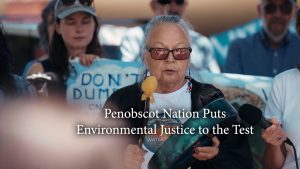
“It’s Not Just Us: Penobscot Nation Puts Environmental Justice to the Test”
and an essay by Penobscot Tribal Historian Maria Girouard, “A Glimmer of Hope.”
Penobscot Nation, Juniper Ridge Landfill, and Environmental Justice.
“It’s Not Just Us: Penobscot Nation Puts Environmental Justice to the Test” shares reactions to the Maine Superior Court’s January 2026 decision agreeing with Penobscot Nation and Conservation Law Foundation, that the Maine’s Department of Environmental Protection had failed to take into account Environmental Justice, as required by law, when considering the proposed Juniper Ridge Landfill expansion.
The DEP has until March 23rd to respond to the court’s request to “consider the cumulative environmental burdens borne by the Penobscot Nation” and the Nation’s connection to the Penobscot River.
~~~~~~~~~~~
Glimmer of Hope In Decades-Old Trash Clash
Essay by Maria Girouard, Penobscot Tribal Historian
August 25, 2015
TO: Lynn A. Caron
Maine Department of Environmental Protection
RE: Juniper Ridge Landfill Expansion
Dear Ms. Caron,
Please accept this letter as a formal request for a public hearing regarding the Juniper Ridge Landfill Expansion/ Natural Resources Protection Act, Application # DEP #L-24251-TG-C-N.
I have grave concerns for the water, particularly the integrity of the wetland acreage that is connected to Penobscot tribal/ traditional hunting, fishing, and gathering territory located along Birch Stream, and concerns for the watershed where this mega-dump is situated. Many locals get their drinking water from this very watershed where Casella proposes to dump over 8 million tons of waste, the vast majority of it from out-of-state. This is a serious environmental justice issue which should be a concern to all citizens of Maine…. [2015 MLG public comment]
For decades pleas had fallen mostly on deaf ears as local citizens stood their ground against a growing mountain of trash, the Juniper Ridge Landfill. The correspondence from August 2015 to the Maine Department of Environmental Protection could easily have been written in 2025 with all the same concerns being cited and overlooked. However, a glimmer of hope arrived January 9, 2026 in the form of a favorable court decision in the case Penobscot Nation and Conservation Law Foundation v. Maine Department of Environmental Protection.
Penobscot Nation brought this case before a judge because a recent determination made by the Department of Environmental Protection (the DEP) regarding the Juniper Ridge Landfill expansion failed to take into account the disproportionate environmental burden that the Tribe has had to endure by the Juniper Ridge Landfill (JRL).
One step in the landfill application process requires a Public Benefit Determination. Last year the DEP had determined that the proposed Juniper Ridge Landfill expansion would provide a substantial public benefit. The Penobscot Nation and countless others thought not, stating that dangers stemming from JRL operations far outweighed public benefit.
The January 2026 Superior Court decision did not uphold the DEP’s determination. Instead it found that the Department failed to complete sufficient fact-finding, or at least did not show that they considered countless testimonies provided during the decision-making process. Testimonies from Maine and Penobscot tribal citizens that spoke to environmental justice concerns, the exorbitant burden placed on the Penobscot River and its people. Concerns for the watershed, all who live within it or whose drinking water comes from it. Concerns extended to the health of fish and wildlife, the water and now heightened concerns for air quality with regular releases of methane gases into the environment, “burning off” and the occurrence of fires at the landfill.
Justice Bruce Mallonee heard the pleas even if the DEP chose to ignore them. He also called attention to DEP’s failure to address the fact that already lining the River are over 70 landfills and the unique relationship Penobscot Nation maintains with the River. While most of the landfills are no longer active, the waste remains. The court sent the case back to the DEP ordering that a revised determination be produced by March 23. The DEP was told specifically to “consider the cumulative environmental burden borne by the Penobscot Nation, including the existence and condition of other landfills near it, and whether these environmental burdens and the Penobscot Nation’s intimate relationship with the Penobscot River permit a finding that the proposal fulfills environmental justice.”
The recent Superior Court decision is a testament to how environmental justice laws should work to protect the people, pausing what has been called “a ticking time bomb.” Many Penobscot tribal members cheered the decision as a hard-fought win for the wildlife, the water, air, and the people. Others remain skeptical and anticipate a drawn-out process. Penobscots have stewarded the lands and waters where the Juniper Ridge Landfill is located for countless generations through centuries of industrial assault on the environment. While the win may not be the end of the saga, Penobscot Nation remains committed to its stewardship for the long haul.
Penobscot Jasmine Thompson-Tinter commented on the decision, “Amazing work being done across the ground to hold those who have destructed our lands accountable. The conversations don’t stop, if anything they give more ground to grow in a better direction. Money shouldn’t be what decides the factors of true wealth. True wealth is when our younger generations have clean water to access.”
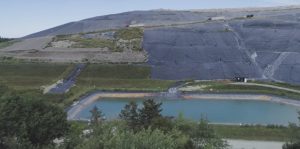
Juniper Ridge Landfill is owned by the State of Maine and operated privately by out-of-state billion dollar waste management company, Casella Waste Systems, Inc. The current footprint of the landfill spans 179 acres. The proposed expansion, if approved, would increase the landfill footprint an additional 61 acres. Juniper Ridge Landfill is situated between Pushaw Stream and Birch Stream, two streams flowing directly into the Penobscot River.
The DEP has until March 23rd to respond to the court’s request to “consider the cumulative environmental burdens borne by the Penobscot Nation” and the Nation’s connection to the Penobscot River.
Join Sunlight Media Collective
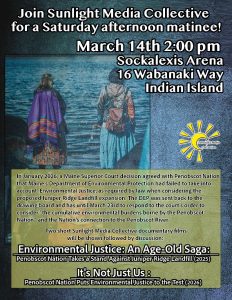
Saturday, March 14th at 2pm at the Sockalexis Arena
16 Wabanaki Way, Indian Island, Penobscot Nation
For an afternoon of films and discussion on Environmental Justice and Juniper Ridge Landfill
• Environmental Justice: An Age-Old Saga: Penobscot Nation Takes a Stand Against Juniper Ridge Landfill (2025)
• It’s Not Just Us: Penobscot Nation Puts Environmental Justice to the Test (2026)